
The lives of Gilbert & Sullivan: A summary
To truly understand the revolutionary pair, let’s explore the lives of each.
Early life and education
William Schwenck Gilbert (1836-1911) trained as a lawyer and was called to the Bar before pursuing a career as a writer, playwright and librettist. From 1861 onwards he wrote extensively for Fun magazine and other publications, producing stories, sketches, verse and criticism. Many of the comic ideas and topsy-turvy imaginings that later characterised the Gilbert and Sullivan operas first emerged in these early works.
Arthur Sullivan (1842-1900) demonstrated an interest in the arts from a young age and was a very early musical talent. Sullivan’s father was a military bandmaster, where he was able to learn to play every instrument in the band before he turned eight years old. His father was able to recognise Arthur’s potential and made sure he could receive a proper musical education. By the age of thirteen, Sullivan had his first piece of music published. In the summer of 1856 Sullivan, despite being the youngest entrant, won the competition for the first Mendelssohn Scholarship. This enabled him to study at the Royal Academy of Music.
Career highlights
Gilbert experienced a prolific career, marked by his notable achievements as a librettist across theatre. After beginning his career as a playwright and journalist, Gilbert went on to create early works that earned him admiration for their portrayal of comedy and drama. His librettos remained innovative, blending wit and detailed plotting in nineteenth-century opera.
Arthur Sullivan distinguished himself as a composer and musician during his career. Sullivan remained a versatile artist throughout his time in opera, being able to venture into both comic and serious works, including a selection of orchestral and choral pieces, such as The Light of the World (1873) and the Irish Symphony (1866).
Alongside their individual careers, a historic moment in time was marked when the pair were first brought together in 1871 to produce Thespis, a Christmas extravaganza for West End theatre owner, John Hollingshead. However, their first complete operatic collaboration wasn’t until 1875, where Gilbert’s libretto for Trial by Jury needed a composer, leading to a first operetta and the start of a working relationship they endured for many years.
The pair’s collaboration reached its peak in the late 1870s and 1880s, following the encouragement of Richard D’Oyly Carte whose company produced popular Gilbert and Sullivan works at London’s Savoy Theatre. The collaborations are collectively known as the Savoy Operas, although several of the works were first performed elsewhere before the Savoy Theatre opened in 1881. The D’Oyly Carte company was dedicated to the Gilbert and Sullivan oeuvre and continued long after the deaths of the composer and librettist – keeping a somewhat moribund performance tradition alive right into the 1970s.
In 1890, the duo began to experience serious tensions, which eventually led to the demise of their partnership. The groundbreaking and incredibly successful duo lasted for over two decades, between 1871 to 1896, producing an astounding fourteen operas.
Later life
Life after the fall out was interesting, and a significant change for each. In his later years, W.S. Gilbert continued with his theatrical pursuits and projects. However, as popular culture evolved, his artistic works faced challenges in maintaining the same level of popularity that he had had with Sullivan. After pursuing new creative ventures, such as writing plays and working with different composers, Gilbert was able to continue being an influential figure in the London theatre scene.
1907 saw Gilbert knighted, and 1911 saw the performance of his final play, The Hooligan. Sir W.S. Gilbert sadly passed away on 29th May 1911 at the age of 74, suffering from a heart attack while trying to save a woman from drowning in the lake on his estate.
Arthur Sullivan’s later years saw him build a diverse and greatly successful career. Following the breakdown of their partnership, Sullivan set out to establish himself as a serious composer, distancing himself from the comedic, light-hearted operas that were a result of his work with Gilbert.
When he had been knighted back in 1883 by Queen Victoria, the sovereign took the opportunity to encourage Sullivan to write a grand opera. Nearly a decade later, the result was Ivanhoe (1891), after Walter Scott’s celebrated novel. Ivanhoe enjoyed an impressive initial run of performances, but failed to establish itself in the repertory and is now a rarity.
William S. Gilbert and Arthur Sullivan enjoyed a remarkable career and partnership that left behind one of the most profound legacies in opera. The duo completely transformed the operetta genre, introducing a unique blend of comedic librettos and beautiful compositions. Their Savoy operas have become synonymous with the highest and most respected standards of light opera. Most of these fourteen operas continue to be performed to this day, attesting to the timeless quality of their creative works. One of the most famous partnerships in opera, William S. Gilbert and Arthur Sullivan’s compositions transitioned opera into an accessible and wildly comedic experience for everyone.
Gilbert & Sullivan’s musical style and influence
Sullivan’s music, especially in his collaborations with Gilbert, is never less than superbly crafted. His musical style draws on British and European traditions, with elements of Victorian church music, the drawing-room ballad, and the operas of Donizetti, Bellini, and middle-period Verdi melded into one. This fusion of different genres and traditions made Gilbert & Sullivan’s operas a huge success throughout Europe and overseas.
Sullivan’s gift for matching Gilbert’s often tongue-twisting words to memorable melody is particularly noteworthy in Sir Joseph Porter’s patter song in HMS Pinafore, or the Modern Major General song from Pirates of Penzance. However, Sullivan can be as subtle as Schubert when necessary (for example, the opening women’s chorus in Pirates).
Freed of the copyright restrictions of previous generations, the Gilbert & Sullivan repertoire, when presented in wholly fresh interpretations (such as Jonathan Miller’s non-Japanese Mikado set in a 1930s English seaside hotel), has won new audiences for their most famous operas.
Gilbert & Sullivan’s most famous songs
Watch performances of the following songs:
‘The Major General’s Song’ from The Pirates of Penzance (1879)
‘Nightmare Song’ from Iolanthe (1882)
‘I’ve got a little list’ from The Mikado (1885)
‘A British Tar’ from H.M.S. Pinafore (1878)
‘Tripping Hither, Tripping Thither’ from Iolanthe (1882)
‘My eyes are fully open’ from Ruddigore (1887)
‘Three Little Maids’ from The Mikado (1885)


Gilbert & Sullivan’s most famous operas
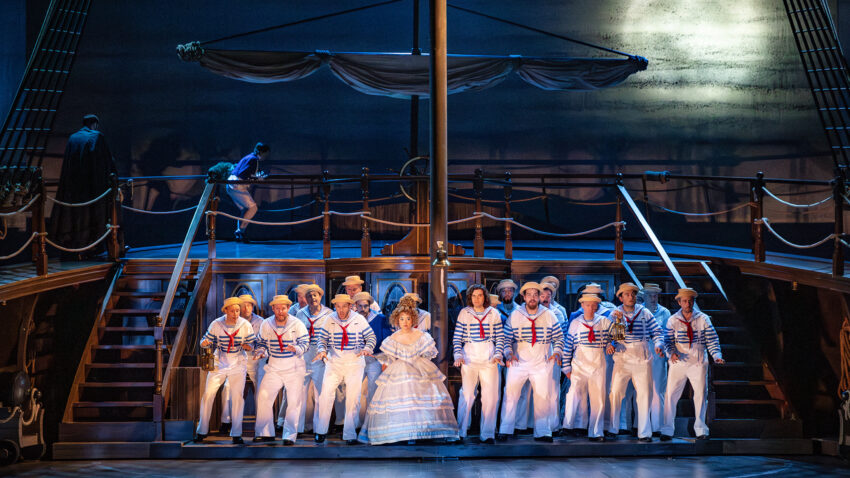
HMS Pinafore

The Pirates of Penzance

Iolanthe

The Mikado

The Yeomen of the Guard
- HMS Pinafore (1878)
- The Pirates of Penzance (1879)
- Iolanthe (1882)
- The Mikado (1885)
- The Ruddigore (1887)
- The Sorcerer (1887)
- The Yeomen of the Guard (1888)
- The Gondoliers (1889)
Music in action

ENO Iolanthe: None Shall Part Us
Watch Marcus Farnsworth and Ellie Laugharne sing None Shall Part Us from Cal McCrystal‘s production of Gilbert & Sullivan‘s Iolanthe

ENO Iolanthe: Oh, Foolish Fay
Queen of the fairies, watch Yvonne Howard and the ENO chorus sing Oh, foolish fay from Cal McCrystal’s production of Gilbert & Sullivan‘s Iolanthe.

ENO HMS Pinafore: Never Mind the Why and Wherefore
FAQs
The final Gilbert & Sullivan comic opera was The Grand Duke, which premiered at the Savoy Theatre in London on 7th March, 1896. Their last collaborative piece is a satirical story that revolves around a brewing revolution, a love story, and the problems caused by constitutions. Despite the duo’s previous unwavering success, this final work was not a hit with audiences.
Composer Arthur Sullivan and librettist W.S. Gilbert collaborated on a total of fourteen operas. All of which were originally performed at the Savoy Theatre in London.
The following list consists of Gilbert & Sullivan’s operas in order:
- Thespis (1871)
- Trial by Jury (1875)
- The Sorcerer (1877)
- H.M.S. Pinafore (1878)
- The Pirates of Penzance (1879)
- Patience (1881)
- Iolanthe (1882)
- Princess Ida (1884)
- The Mikado (1885)
- Ruddigore (1887)
- The Yeomen of the Guard (1888)
- The Gondoliers (1889)
- Utopia, Limited (1893)
- The Grand Duke (1896)
The ENO frequently hosts productions of the duo’s acclaimed works.
This season Trial by Jury & The Zoo come together in a wildly entertaining pairing. More information can be found here
Previous ENO seasons have included performances of Gilbert and Sullivan’s: The Yeomen of the Guard, Iolanthe, H.M.S. Pinafore, The Pirates of Penzance and The Mikado.
Creative differences, arguments over finances, frictions caused by juxtaposing personalities, and an inevitable burnout all contributed to the end of their professional and personal relationship. However, the exact, defining reason for the duo’s falling out has been debated and speculated ever since.
Related Content

The Beginner's Guide to Gilbert & Sullivan

The Beginner's Guide to Operetta